 CIRCUI-T
CIRCUI-T
Compute Infrastructure Resilience under Contested Utilities and Interdiction - Taiwan
Student research. Testing build 0.1.0-F2j. The two Tainan scenarios are loaded; every facility, capacity and outcome in them is SIMULATED or ILLUSTRATIVE unless a source is named beside it.
What this is
CIRCUI-T is a modeling instrument for one question a war college tabletop exercise needs answered: when the utilities that feed a compute cluster are contested, what keeps running, for how long, and for whom. It takes the Tainan area of southern Taiwan and lets a group cut a gas import, drop a substation, sever a cable, jam a satellite link or island a campus, then watch ninety days play out one day at a time.
The solver is a deterministic network-flow engine. Compute is one of its eight commodities: data centers produce it from electricity, water and connectivity.
Two research questions
How exposed are the Tainan compute and fab cluster, and its military-usable compute and bandwidth, to an LNG blockade, kinetic strikes, cyber degradation and submarine cable cuts over an ILLUSTRATIVE 90-day horizon?
What changes when the user adds hypothetical facilities, such as small modular and micro reactors, new data center classes and satellite gateways? Each is labeled ILLUSTRATIVE or SIMULATED.
The mission model
This is a concept walkthrough of the planned design, not output of the terminal on this site.
The compute pool
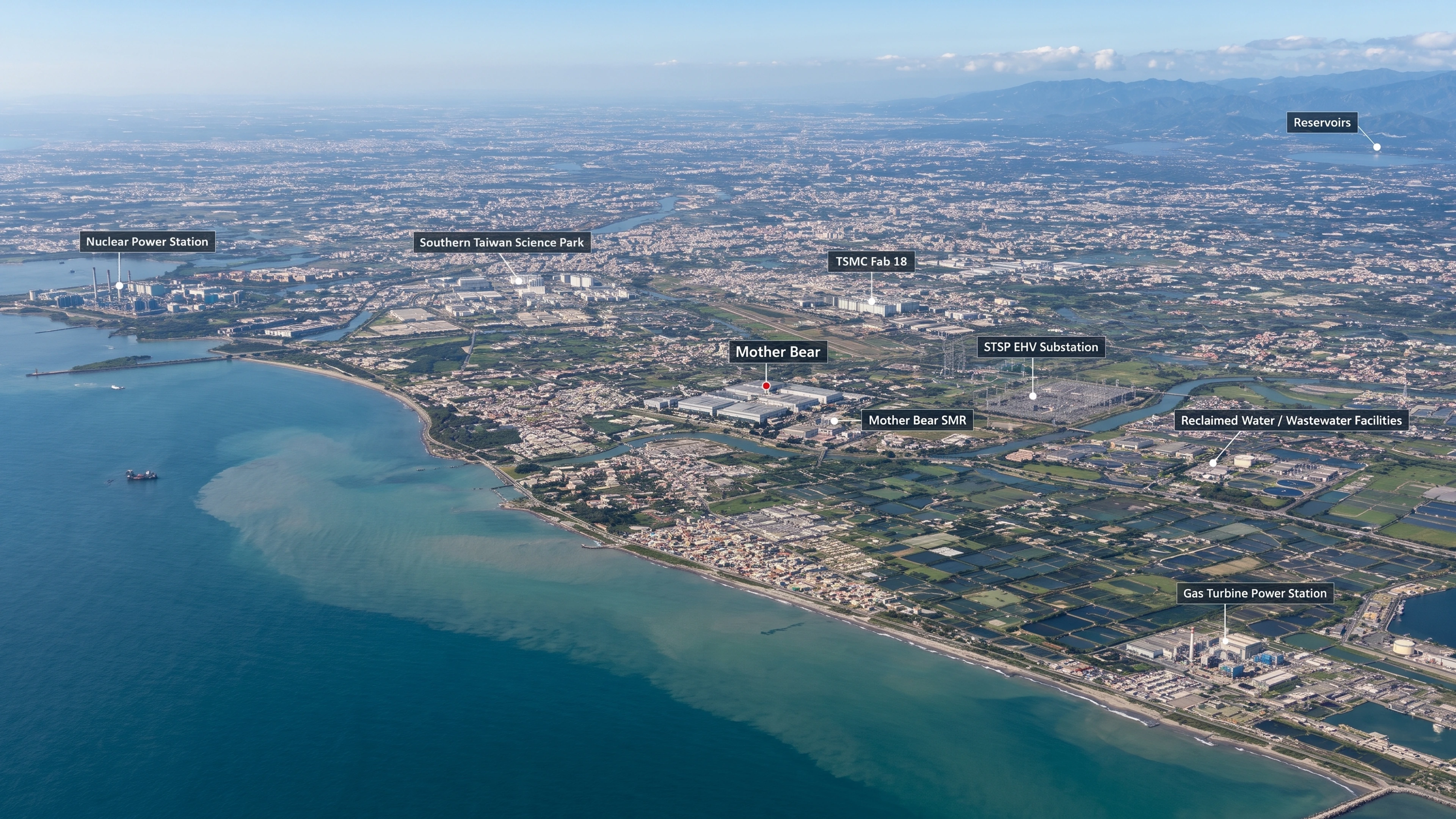
Mother Bear, the Advanced Technology Center (ATC), is the apex whose compute everything draws on. Each mission belongs to an ATC and gets its compute there. The model allows several ATCs; Mother Bear is the only one in the Tainan design. An ATC has no demand of its own and no first call on its own compute.
Notional Mother Bear supplies ILLUSTRATIVE 1,000 IT-MW. The campuses add SIMULATED 500 IT-MW to the same pool: SELF-DERIVED 1,500 IT-MW in all. Mother Bear has dedicated power: a small modular reactor wired only to it and a gas plant that burns Yong-An LNG, both ILLUSTRATIVE.
The ATC page on this site shows a separate, larger ILLUSTRATIVE 5,000 IT-MW campus, not Mother Bear.
Mission priorities
Military, Civil and Commercial form the columns; Critical, Secondary and Miscellaneous form the rows. Read the ranks across each row before moving down.
Facility defense appears in Military Critical, Civil Critical and Commercial Critical as separate missions of one family. Joint ISR processing and C2 cloud sit at rank SELF-DERIVED 4, behind Commercial Critical: they drop before any Critical mission when the ATC runs short.
Source: CIRCUI-T mission model design of record v5.2.
Serving when short
Fill each cell whole in rank order before serving the next. Inside a short cell, every mission gets the same fraction of its need. GOOD means fully served, DEGRADED partly served and DOWN nothing served. Every mission here sits at one ATC and no route limits a mission, so the design's route-limited rule does not come into play.
Fabs and chips
Each fab converts power, water and compute into output, which follows its least-served input. The ILLUSTRATIVE 24 fabs need 21.5 IT-MW of compute in all, served at rank 3. A fab with no compute runs at half output. When power or water is short, the campuses and the ATC are served first, then the fabs.
ILLUSTRATIVE Chips are one class: 1 chip IT-MW restores 1 IT-MW. Every compute site holds a stock and burns 0.00025 chip IT-MW per IT-MW per day, about 9 percent a year. The campuses hold 120 days; Mother Bear holds 30 days. Fab 18 alone produces 20 chip IT-MW a day into one Tainan-wide pool with no routes. Receipts are usable the next day. At an empty stock, each unit of unmet burn removes 1 IT-MW of capacity.
Chip design, ILLUSTRATIVE 150 IT-MW in Civil Critical, is Mother Bear's own work designing new chips, not fab operations. No outcome, day count or blockade result has been measured for this model.
Status
The terminal on this site does not run this model yet. It serves workloads in three ranked tiers: Military reserve, Critical civil and Commercial. Both Tainan scenarios keep a SIMULATED 15 percent military reserve at every site; Mother Bear is in neither scenario. Facilitate and MAP already label these tiers Military, Civil and Commercial while serving them the old way. The mission-model rounds are planned to bring nine-cell serving, the ATC readout, fabs as converters, chips and new Tainan scenarios with Mother Bear into the terminal. This walkthrough's served figures are this page's arithmetic, not terminal output.
Honesty and model boundaries
Every modeled number is tied to a cited source or flagged SELF-DERIVED, ILLUSTRATIVE or SIMULATED. What we cannot measure is stated as a finding.
The model shows relative and structural exposure and does not predict real outcomes. Hypothetical facilities and their capacities, reactors included, are ILLUSTRATIVE or SIMULATED, not claims about existing infrastructure.
Taiwan has had no operating nuclear generation since 17 May 2025 (Taipower shutdown statement, Taipower nuclear plant status). SMRs operate commercially in Russia and China (IAEA SMR Platform booklet).
The modeled grid is a logical network. Where OpenStreetMap shows no connection, 231 SIMULATED feeders (about 257 km) complete the network, each listed in the scenario's ledger. It is not a one-line diagram, and no line or station rating is asserted without a source.
The solver has no dispatch order, so backup generation runs from day 0: a 48-hour diesel stock is gone by day 2 whether or not the grid is up. Batteries are deferred for the same reason.
Fab process loads are SIMULATED shares of corporate totals, never a per-fab rating. No scenario figure is read from the third-party basemap.
Open the terminal
Open the terminal in Facilitate mode: CIRCUI-T Tainan - Consolidation or CIRCUI-T Tainan - Fragmentation. The bare address, /circuit/terminal/, opens CIRCUI-T Tainan - Consolidation in Facilitate mode. Export your work before you leave: the Tainan scenarios are larger than the browser's local autosave can hold.