 CIRCUI-T
The CIRCUI-T Tool
A deterministic infrastructure model of a compute cluster and the utilities that feed it. Eight commodities (electric, water, gas, steam, oil, fuel, data, compute) flow from sources through substations and lines to delivery points; workloads at each delivery point declare what they consume. Data centers are converters: they take electricity, water and a data connection and produce compute, measured in IT-MW, and that compute travels over modeled compute links to the workloads that need it.
Both scenarios carry 500 IT-MW of hypothetical compute, a 15 percent military reserve at every site and the same workloads. Only the layout differs. Consolidation puts the compute in three campuses on the 345 kV backbone. Fragmentation spreads it across ten 50 IT-MW sites on 161 and 69 kV stations, five with a 20 MW microreactor. All placements are SIMULATED. Mother Bear is in neither scenario.
Launch
Export your work before you leave: the Tainan scenarios are larger than the browser's local autosave can hold.
Student research and a testing instrument. Results are SIMULATED from flagged inputs; none has been validated against real outcomes or operator data. Testing only. No release acceptance is claimed for any CIRCUI-T build.
What it does now
This section describes the terminal as built. It serves workloads in three ranked tiers, Military reserve, Critical civil and Commercial, with a military reserve at each site. The planned mission model has an Advanced Technology Center and nine cells; it is not in the terminal yet. See the mission model walkthrough on the home page.
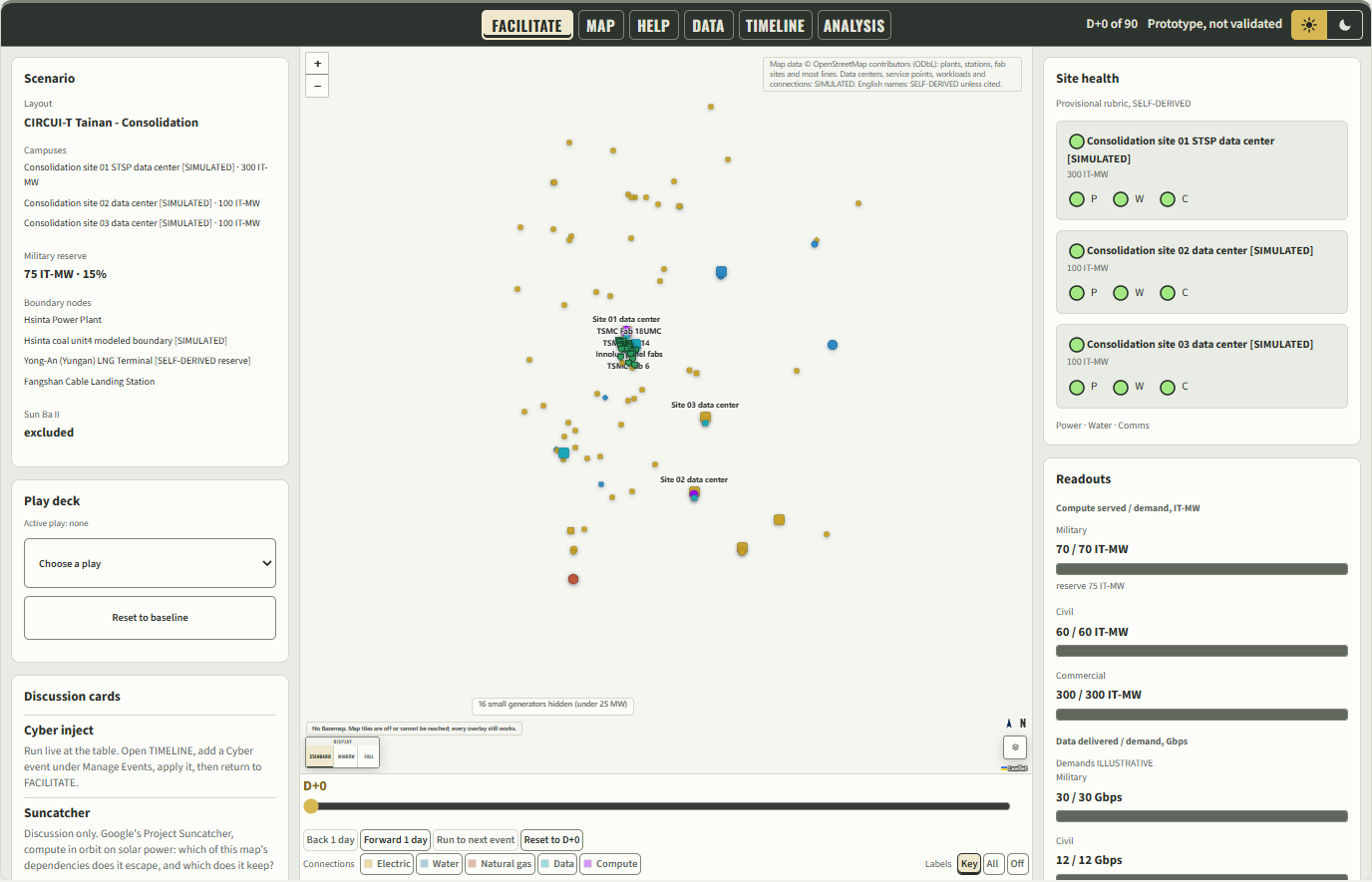
Facilitate
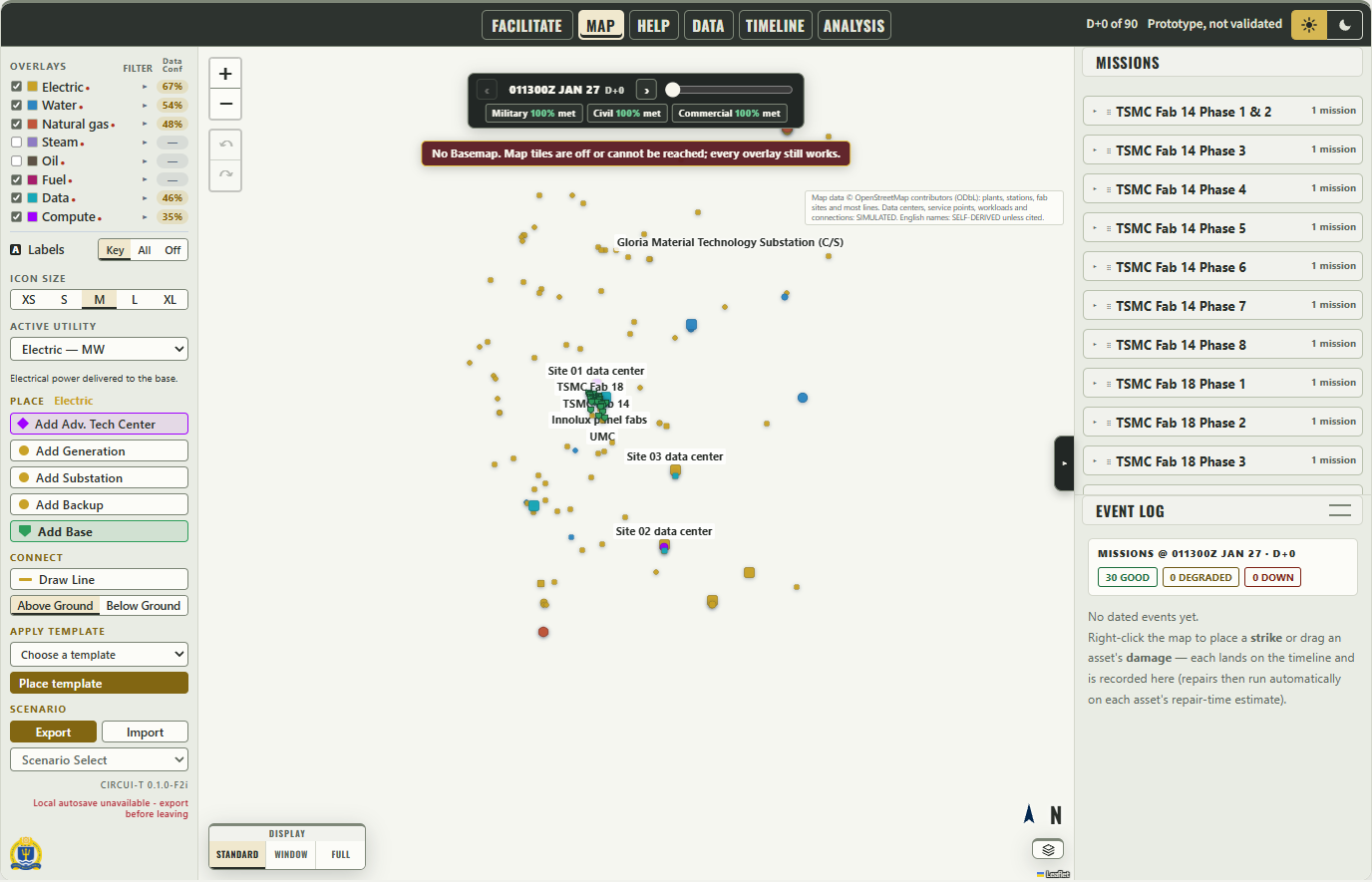
- MAP, HELP, DATA, TIMELINE and ANALYSIS provide the full editor. Facilitate is the projected group screen: it shows the same map, timeline and results and hides the editing controls. Both modes read the same 91-day timeline; Facilitate does not change the calculation.
- Use FACILITATE to return to the projected screen. MAP opens the editor; HELP, DATA, TIMELINE and ANALYSIS open their panels.
- The play deck fires one play at a time. A play is the baseline scenario plus one change, imported as a complete scenario, so firing a second play replaces the first; Reset to baseline reloads the layout.
- Site health reads each data center's inputs from the engine's daily results: Power is the share of its electric input received, Water the share of its water input, Comms the share of its data input. Green is full supply, yellow is partial supply, red is none, grey is a destroyed site with its days to repair. Water is a degrading input in the Tainan scenarios, so it can turn a site yellow but never red on its own. The thresholds are SELF-DERIVED until the exercise group ratifies them; the panel header says so.
- Readouts show compute served against compute demanded for each tier the scenario defines, in IT-MW, as a fraction and a bar; workloads whose delivery point has been removed are excluded and counted in the footer. The editor tier bar instead counts workloads at or above half service.
- Data delivered reads the same daily results as compute served: for each tier, the data that reached its workloads against the data they demand, in Gbps, with orphaned workloads excluded. The Comms dot on a site tile reads only the campus's own data link, so a cable cut can leave every tile green while workloads go short; this readout is where that shows. A workload can have its compute allocated and still be short of data. The data demands are ILLUSTRATIVE.
- LNG days remaining shows the days of gas left in the national store and at Yong-An at that day's net draw (draw less refill). It is a display formula, SELF-DERIVED, and does not feed the model.
- Power mix shows the electric source capacity available on the selected day by fuel, gas against everything else; it is capacity that could be dispatched, not output delivered, and it is SELF-DERIVED from the scenario's source ratings.
- Choose Light or Dark with the two theme buttons. The choice is kept for the current browser session only.
- English display names are used in the map and ANALYSIS displays. TIMELINE, the editors and ANALYSIS's Excel export retain the raw names. Display aliases do not rename each record's Name or change its modeled behavior.
- A basemap layer control with Stadia Maps' Alidade Smooth, Alidade Smooth Dark, Alidade Satellite and OSM Bright, and OpenStreetMap.
Editor
- Use MAP to edit, TIMELINE for dated changes and ANALYSIS for a read-only node-outage sweep. Add Adv. Tech Center places the existing DC Super Intelligence template.
- Load one of the two Tainan scenarios, or build your own. Right-click to author damage or a cyber effect, record a physical assessment on an asset, apply a facility template, open a microgrid's point of common coupling for a range of days, then scrub the 90-day timeline: LNG inventories count down, gas plants stop when their store is empty, backup generators burn through their stock, repair episodes accrue, and every workload reports whether it is GOOD, DEGRADED, DOWN or IDLE. The complete scenario workbook carries causal and audit state, dated events, catalog snapshots and the display-only view day.
- A multi-commodity cascade engine: deterministic max-flow across electric, water, natural gas, steam, oil, fuel, data and compute, with Military reserve, Critical civil and Commercial tiers allocated in priority order and per-dependency critical or degrading handling.
- Facilitate and MAP display Military, Civil and Commercial; the stored tier names remain unchanged in DATA and workbook exports.
- Compute as a commodity: data centers are converters with electric, water and data inputs, IT-MW output, PUE and WUE fields, a cooling-mode preset and a scenario-wide PUE multiplier. Compute reaches workloads over modeled compute links.
- A military reserve: each data center sets aside a percentage of its compute for Military reserve workloads; single-site workloads are placed whole or reported short.
- Stored gas: when a scenario enables it, gas plants draw from explicit inventories that refill over named import lanes from external sources; the Tainan scenarios model Yong-An and a national stock this way.
- Seventeen facility templates with provenance on the card: five data center classes, SMRs and microreactors, a grid battery block, a fuel cell class, a self-powered campus, a microgrid composite with a PCC switch, and connectivity objects (constellation, space gateway, satellite terminal, wireless backhaul).
- Two Tainan layouts, Consolidation and Fragmentation, embedded from workbooks with a Sun Ba II toggle, twelve plays, and a scenario ledger of every SIMULATED connection.
- Governed tools: governed kinetic and cyber effects with tri-state cyber assessment, damage and hardening rules, physical assessments, the 90-day event-sourced timeline, governed repair episodes, the scenario workbook (now v18 with guarded readers back to v10), read-only Dependency Analysis, governed catalogs and the DATA editor.
Templates
The Apply template control fills a new or existing asset from a catalog of seventeen facility classes. Each card shows the flag (CITED, SELF-DERIVED, ILLUSTRATIVE or SIMULATED) and the source string. Data center templates also place a diesel generator sized to the facility's electric load with a stock in hours; the burn is SELF-DERIVED at 0.0694 gallons per kWh, calculated as 30,000 / (18 x 24 x 1,000) from SIMULATED teaching inputs of 30,000 gallons per day and 18 MW, with no outside source. Gas-fed templates refuse to apply until gas is a stored commodity in Settings. A template never overwrites a field you have edited since the last apply.
The microgrid composite adds local generation and, if you choose, a battery, then converts the facility's single upstream connection into a point of common coupling. Open the PCC for a day range and the facility runs on what is inside the island. If the local substation has more than one upstream connection, the planner refuses until you pick one, because a composite that leaves a bypass is not a microgrid.
Plays
A play is a scenario workbook with one change added on top of a baseline: damage on a named asset on a named day, or a PCC opened for a range of days. Six plays ship for each layout: an LNG blockade at day 1 that cuts both import lanes; a Nanke 345 kV substation outage at day 1; a Fangshan cable cut at day 1; a carrier hotel service loss at day 1; gateway jamming at days 2 and 9; and islanding of the science park campus from day 5 to day 19. The outages are generic functional-loss rows. Weapon-specific strikes and cyber effects are not pre-authored.
What's coming
Listed so the gap between what the terminal does today and where it is going stays explicit:
Planning candidates
- Mother Bear, the Advanced Technology Center: ILLUSTRATIVE and notional, near TSMC Fab 18, the apex whose compute every mission draws on. It is added to both layouts beside the existing campuses, which join it in one compute pool.
- Power of its own for Mother Bear: an SMR wired only to it, and a gas plant that burns Yong-An LNG, so a blockade reaches it.
- Missions at the Advanced Technology Center in nine cells: Military, Civil and Commercial, each Critical, Secondary and Miscellaneous. Serving follows rank order SELF-DERIVED 1 to 9, with the same fraction for every mission in a short cell, replacing today's three ranked tiers and the military reserve. The readout shows compute served against compute needed, tier bars for Military, Civil and Commercial, and counts of DEGRADED and DOWN missions.
- Fabs as converters: power, water and compute in, output out, with their compute need served at rank SELF-DERIVED 3 and a fab output share on screen.
- Chips as a stored input: a stock at every compute site, burned at a steady rate, with Fab 18 the only producer.
- Revised plays for the proposed new layouts.
Every value added with Mother Bear, the missions, the fabs and the chips will carry a cited source or its flag, ILLUSTRATIVE, SELF-DERIVED or SIMULATED, and will say which.
Later
- A compute mix for each data center.
- Fab supplies by delivery, with a supply that can be cut and fab output that scales with it.
- Reactors and batteries assigned to named facilities.
- Water storage.
- Sourced fab and water figures in place of today's SIMULATED shares.
- Plays that stack, run as changes on the baseline.
- Dispatch-aware fuel draw, so backup generators burn only for the output they deliver, and battery dispatch, so storage can ride through an islanding window.
- A first-class interdiction event that zeroes resupply for a period with a step restoration.
- Gateways and towers as electric loads, so communications failure follows grid failure.
- Automatic islanding on upstream loss rather than a user-set day range.
- Process gas at fabs, and a fab restart clock.
- Scenario persistence beyond the browser's local storage quota.
- A direct-to-device throughput lever.
These are planning candidates, not commitments.